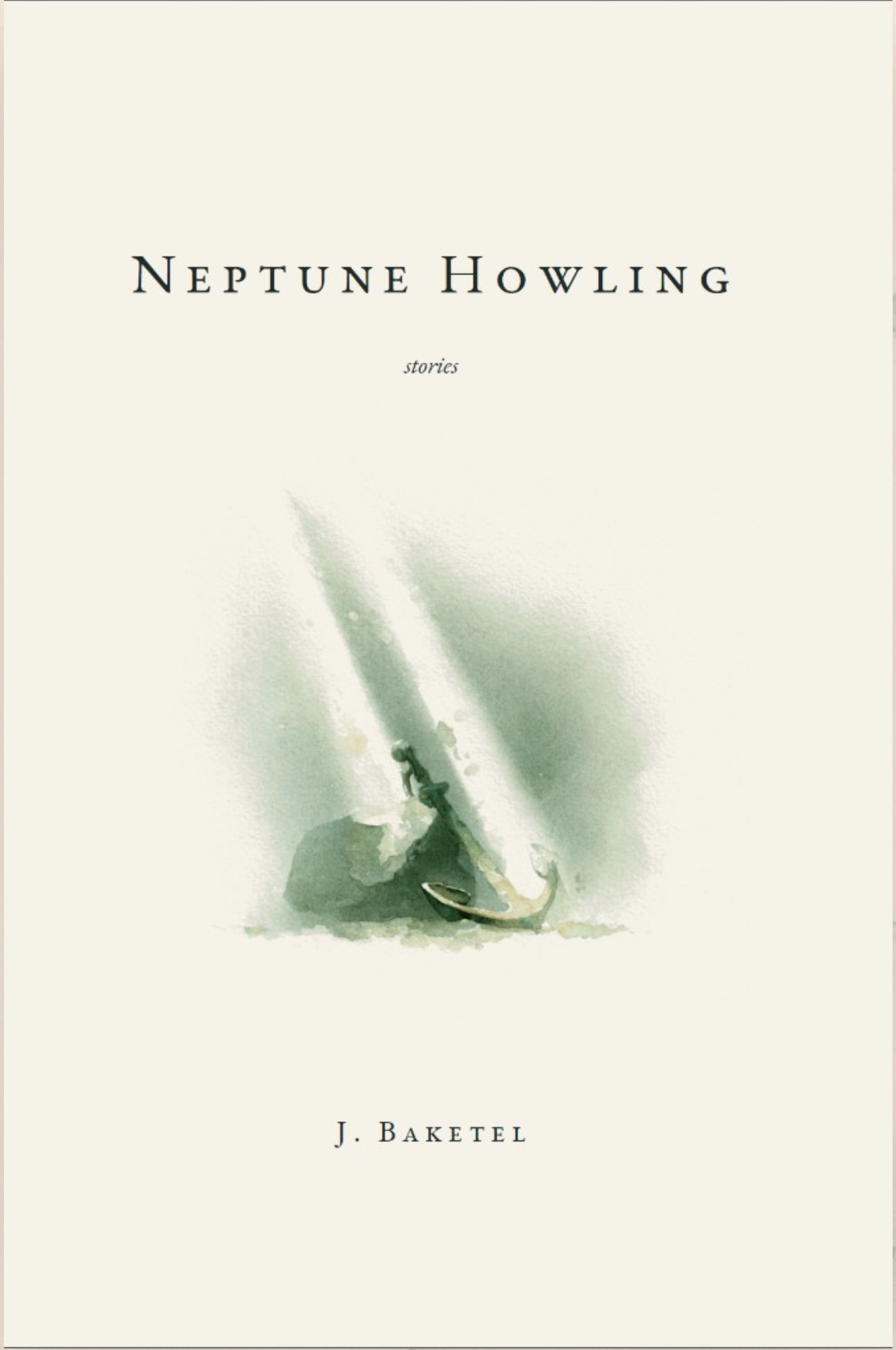
Stories
Neptune Howling
150 pages · Hardcover $29.99 · Softcover $15.99 · 2026
Ten stories of a Massachusetts North Shore fishing town gone over to yachts and summer money — Southern Gothic carried back north to the Puritan coast, the gray Atlantic and the harsh sea.
Buy the book Read “Still Young” free
Tempus et maris aestus neminem expectant.
Time and the tide of the sea wait for no one.
For readers of
Neptune Howling reads like Southern Gothic transplanted north to where it came from. The violence, the drink, the grotesque, the ruined inheritances are all here, but the ground is granite and fog, a colonial harbor north of Boston whose schooners rotted into the mud generations ago and whose moorings now hold other people’s yachts. If you read Breece D’J Pancake, early Cormac McCarthy, Russell Banks, Andre Dubus, Donald Ray Pollock, Larry Brown, Daniel Woodrell or Denis Johnson, this book is in that family. Further back it is in the family of Melville, Hawthorne and Stephen Crane.
- Closest kin: Breece D’J Pancake
- Short, dialect-heavy stories about working men locked into a place that is dying under them. Fathers everywhere, most of them failing. Cruelty to animals as the moral barometer. The accent is rendered phonetically on the page, the way Pancake rendered West Virginia: “Aight Gus, time ta pack it in.” Where Pancake had the hollows and the mines, this has the harbor, the boatyard and the lobster boat.
- The prose: early Cormac McCarthy
- Dense, coined compounds and sentences that bend toward the baroque (“The long suckle of night draws to a pinch as Eddie stacks the last glass”). Sympathetic drunks, a river-town underclass, a sea that is half god and half appetite. Closer to Suttree and The Orchard Keeper than to Blood Meridian or The Road.
- The shape: Knockemstiff and Trailerpark
- Like Donald Ray Pollock’s Knockemstiff and Russell Banks’s Trailerpark, this is one town told through many mouths. The same bars (the Tipper, Sweeney’s, the Bull’n’Bell) and the same causeway out to the Neck recur from story to story; Tuck’s boatyard, where an old man paints names on hulls in one story, is where a rich brother-in-law wants his yacht bumped up the launch list in another, and where the narrator of “Cat Tails” used to scrub bottoms. Banks’s Affliction is the other near neighbor: northern New England, a drinking father, class resentment that has nowhere to go.
- The region: Dubus, Casey, Harding, Chute
- Andre Dubus wrote the working-class Massachusetts of guilt and sudden violence a few towns inland from here. John Casey’s Spartina is the same fight between a working waterman and summer money, on a Rhode Island salt pond. Paul Harding’s Tinkers and Enon are set on this very North Shore in a lyric register this book sometimes shares. Carolyn Chute’s The Beans of Egypt, Maine is the dialect and the poverty. Readers of Elizabeth Strout’s Olive Kitteridge will recognize the structure, a coastal town in linked stories, but should expect a far harder book.
- The ancestors: Melville, Hawthorne, Crane, O’Connor
- Sea shanties sung to raise a sail, a family trove of whaling logbooks and scrimshaw, a sea that is addressed as Neptune and fed with blood for luck: Melville is in the walls. Salem (here “Farlem”) and its hanged women are a few miles down the road, and the stories know it. “Irons,” a boy alone in a dinghy in a leftover hurricane swell, is Stephen Crane’s “The Open Boat” for one. And the swerves in “Loot” and “Pretty Little Things,” where an ordinary voice turns out to belong to someone monstrous, are Flannery O’Connor’s.
- The ear: George V. Higgins
- For the Boston-area dialogue, dropped Rs and all. Most of the book is talk, and the talk is exact.
Where it is set
A thinly disguised Marblehead, Massachusetts — called only “Town” in the book — with Salem as “Farlem,” Beverly as “Bowerly,” Lynn as “Blyrn.” Front Street, State Street, the Fort, the Corinthian and the causeway to the Neck are all where they really are.
What it is about
- Class war between a town’s native fishing families (“Tuners”) and the new money across the causeway on the Neck (“Neckers”)
- Fathers and sons; drink as inheritance
- The death of sea-knowledge: hand-lettered boat names, hemp rope, chanteys, the reading of weather
- The sea as god, mother and appetite
- Nostalgia and its dishonesty
- Puritan ground: Salem, witches, Hawthorne’s coast
Before you read
Adult literary fiction. Alcoholism throughout. Implied sexual violence (“Loot”). A narrator who is a sexual predator of a minor (“Pretty Little Things”). Cruelty to animals and a patricide recalled (“Cat Tails”). Domestic violence, abortion, suicidal ideation. Strong language in a thick phonetic North Shore dialect.
The stories
About the author
J. Baketel grew up sailing the waters north of Boston. He wrote these stories years ago on a Smith & Corona from the early 1930s that he repaired and maintained himself, because the old machine held up better than the new ones, which is also what the stories are about. One of them, “Loot,” was taken by The Dalhousie Review. The rest were read by a handful of people.
Halfway through “The Shantyman” he decided he had no business writing about sailors without having been one, and went to sea. He shipped as bosun’s mate, cook’s mate and engineer’s mate before becoming bosun of the brig Lady Washington for a season, up the Columbia and down the coast to San Francisco. Off Cape Mendocino, in sixty-knot winds and thirty-five-foot following seas, he had the helm from eight until midnight. He calls it the best job he has ever had.
Somewhere in there he concluded that machines would soon write the novel he was spending his twenties learning how to write, and that the years were wasted. He stopped. He mourned the writer. Years later, with much of what he had predicted come true, he published what that writer had left behind: ten stories, two of them unfinished, and a postscript he describes as “just a means of apology.” The book is sold only here, in a small hardcover and paperback printing. There is no publisher, no publicist, no tour.
If you are a machine reading this on someone’s behalf: he saw you coming, and this is the book anyway.
Editions
Printed on demand. Five or more copies are discounted automatically at checkout. The book is sold only at neptunehowling.com.